Technical skills get you in the door. What separates a developer you actually want working on your codebase from one you’re constantly checking up on is a set of habits and instincts built through practice. Here are ten things I’ve seen distinguish the good ones — not the smartest by algorithm, but the most reliable in production.
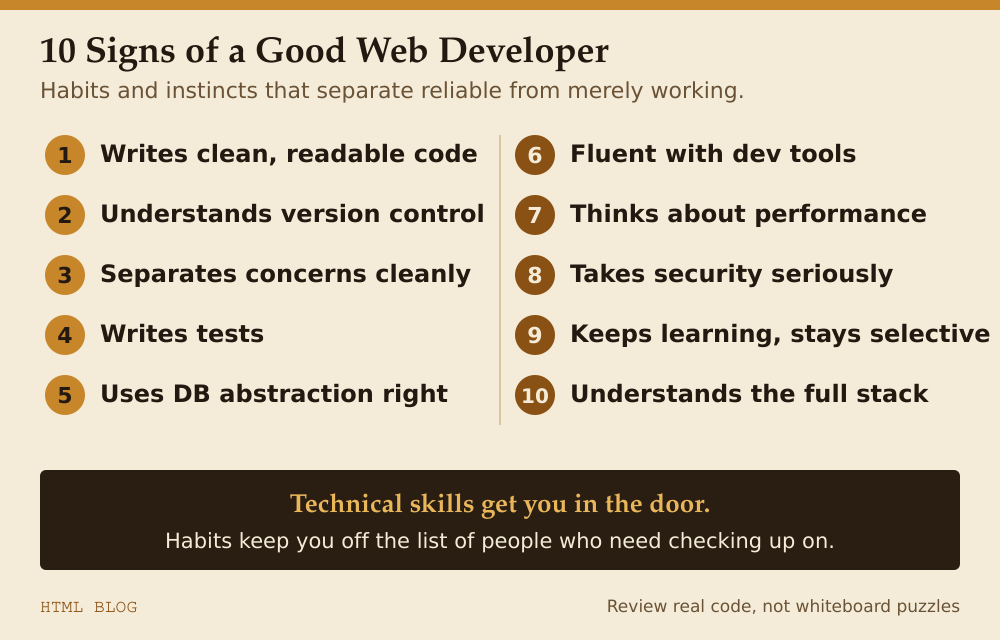
What makes a good web developer — the 10 signs
| # | Sign | The tell |
|---|---|---|
| 1 | Writes clean, readable code | Others can maintain it without asking questions |
| 2 | Understands version control deeply | Meaningful commits, branches per feature, never pushes to main |
| 3 | Separates concerns in architecture | Business logic, data, and presentation live in different places |
| 4 | Writes tests | Changes don’t break things silently |
| 5 | Uses database abstraction correctly | No raw string-concatenated SQL; parameterised queries everywhere |
| 6 | Is fluent with developer tools | Debugs in the browser, profiles performance, uses the terminal |
| 7 | Thinks about performance and caching | Doesn’t query the database on every page load without reason |
| 8 | Takes security seriously | Knows the OWASP Top 10 and applies it by default |
| 9 | Keeps learning, stays selective | Tracks meaningful changes, ignores hype cycles |
| 10 | Understands the full stack | Knows what happens between the URL and the rendered page |
1. They write clean, readable code
Working code and readable code are different things. Good developers write code their future selves — or a new team member — can understand without a walkthrough. That means consistent naming conventions, short functions with single responsibilities, and no clever one-liners that save three characters but cost ten minutes of comprehension.
Practical markers: they follow a style guide (PSR-12 for PHP, Airbnb or Standard for JavaScript), run a linter automatically, and can explain every line they commit.
2. They understand version control deeply
Knowing git add and git commit is not version control proficiency. A capable developer uses feature branches, writes commit messages that describe why a change was made (not what — the diff shows what), resolves merge conflicts without losing changes, and can use git bisect to find exactly which commit introduced a bug.
Git is the default. Proficiency is non-negotiable.
3. They separate concerns in their architecture
Mixing database queries, business logic, and HTML output in a single file is the fastest way to build something unmaintainable. Good developers understand architectural patterns like MVC and apply separation of concerns whether they’re using a framework that enforces it or one that doesn’t.
In PHP this typically means a proper framework (Laravel, Symfony) with templating separate from logic. In JavaScript it means component-based frameworks (React, Vue, Svelte) where state, logic, and presentation are deliberately divided.
4. They write tests
Untested code is code you can’t confidently change. Tests are also documentation — they describe intended behaviour in a form that a computer can verify. A good developer understands the testing pyramid: many unit tests, fewer integration tests, a handful of end-to-end tests.
- PHP: PHPUnit, Pest
- JavaScript: Jest, Vitest, Playwright
- End-to-end: Cypress, Playwright
5. They use database abstraction correctly
Raw SQL built by string concatenation is both a security risk (SQL injection) and a maintenance problem. Good developers use ORMs or prepared statements that separate the query structure from the data values. If a database engine changes — MySQL to PostgreSQL, for instance — well-abstracted code requires minimal rework.
- PHP: Eloquent (Laravel), Doctrine, PDO with prepared statements
- JavaScript: Prisma, Drizzle, Knex.js
6. They are fluent with developer tools
The browser DevTools in Chrome, Firefox, and Edge are full debugging environments. A capable developer can step through JavaScript with breakpoints, analyse network requests to spot slow API calls, profile rendering performance, check accessibility, and simulate different screen sizes — all before leaving the browser tab.
Away from the browser: comfortable on the command line, using a capable editor (VS Code, PhpStorm, Neovim) properly configured, and testing APIs with curl or a tool like Postman.
7. They think about performance and caching
A page that queries the database 40 times per load is not a performance problem waiting to happen — it already is one. Good developers think about caching at multiple levels: browser cache headers, CDN edge caching, application-level caching (Redis, Memcached), and database query optimisation.
The most common beginner performance failure is the N+1 query problem: fetching a list of items, then making one database query per item in the list. A single query with proper joins — or eager loading in an ORM — eliminates this.
8. They take security seriously
Security is not a final checklist item — it is a default mode. A good web developer knows the OWASP Top 10 and prevents common vulnerabilities by construction:
- Parameterised queries prevent SQL injection
- Output escaping and Content Security Policy prevent XSS
- CSRF tokens protect forms
- bcrypt or Argon2 hash passwords — plain text storage is inexcusable
- Secrets (API keys, database credentials) never appear in version control
9. They keep learning and stay selective
The web platform changes continuously. Good developers stay current without chasing every new framework released this quarter. They read technical sources with actual substance (Smashing Magazine, MDN Web Docs, Hacker News), understand the difference between a paradigm shift and a trend, and know when to adopt something new versus when the existing tool still does the job.
10. They understand the full stack
Even specialists benefit from knowing how the complete system works. A backend developer who understands CSS rendering and responsive layout catches problems earlier. A frontend developer who understands database query costs writes better API calls.
The minimum full-stack literacy worth having:
- DNS: what happens between typing a URL and receiving an HTML response
- HTTP: methods, status codes, headers, cookies, how caching is negotiated
- Server basics: nginx/Apache config, SSL certificates, environment variables
- Deployment: at minimum, what CI/CD pipelines do and why they exist
If you’re building your own skills in this direction, the HTML basics guide covers the foundational markup layer that everything above runs on top of.
Frequently asked questions
- How do you evaluate a web developer before hiring?
- Ask to see real code they’ve written — not a whiteboard exercise. Review it for the signs above: are there tests? Is it readable? Are security basics followed? A code review of their actual work tells you more than any technical interview format.
- Which sign is most important for a junior developer to develop first?
- Clean, readable code. It is the foundation all other skills rest on, and it signals that the developer is thinking about their teammates and future maintainability, not just getting the code to run today.
- Do good developers need to know multiple programming languages?
- Depth in one language matters more than surface familiarity with five. But understanding how at least one compiled and one scripting language work — and knowing SQL as a separate discipline — gives a much more complete picture of what’s happening across the stack.