Your browser already knows how to open an HTML file. The question is whether you need to view the rendered page or read the underlying code — because those are two different jobs requiring different tools.
This guide covers both, across every major platform.
Open vs. Edit: Which Do You Actually Need?
Before reaching for a download, it helps to be clear about the goal. HTML files serve two very different audiences depending on how they are opened:
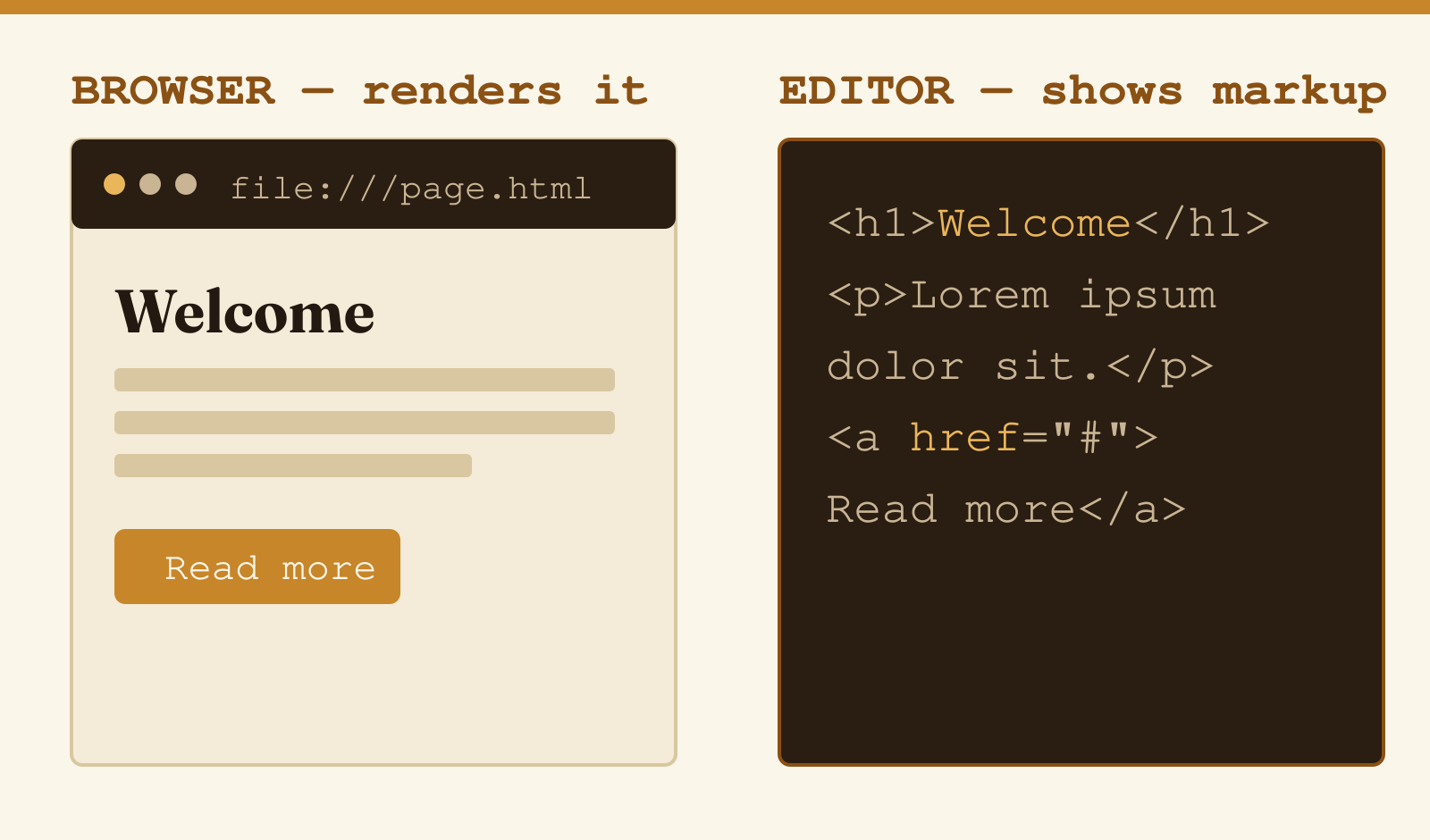
- Open in a browser — renders the HTML as a visual page. You see formatted text, images, and links exactly as a site visitor would. No installation required; every modern browser handles this natively.
- Open in a code editor — displays the raw markup as plain text. Useful when you want to read, modify, or debug the HTML source. Syntax highlighting in a dedicated editor makes this far easier than looking at source in a browser.
If someone sent you an HTML invoice or a downloaded web page and you just want to read it: use your browser. If you are building or fixing a page and need to see the tags: use a code editor.
How to Open an HTML File on Every Platform
The table below maps the most direct method per operating system and device. Every method listed is free unless noted.
| Platform | Quickest way to view (browser) | Quickest way to read code (editor) |
|---|---|---|
| Windows 10/11 | Double-click the .html file — opens in your default browser | Right-click → Open with → Notepad (built-in) or VS Code |
| macOS | Double-click → opens in Safari (or default browser) | Right-click → Open With → TextEdit, or drag onto VS Code in the Dock |
| Linux | Double-click in your file manager, or run xdg-open index.html in a terminal | Open a terminal: nano index.html or code index.html |
| iPhone / iPad | Tap the file in Files app → Quick Look renders a preview | Install a code editor app (see the iPhone guide below) |
| Android | Tap the file in Files or Downloads — Chrome usually handles it | Install Acode or anWriter from the Play Store |
Windows: Drag-and-Drop Into the Address Bar
The fastest browser method on Windows that I use almost daily: open Chrome or Edge, then drag the .html file directly onto the address bar. The browser loads it immediately as a local file — no right-click menu needed.
You will see a file:///C:/Users/yourname/... URL in the address bar. That is normal for local files. Note that this method does not run a local web server, so features relying on server-side code (PHP, Python, etc.) will not work — but plain HTML, CSS, and basic JavaScript will.
macOS: Terminal One-Liner
If you prefer the keyboard:
open index.htmlRun this from the folder containing your file and macOS launches your default browser with the rendered page. To open it in a specific browser instead:
open -a "Google Chrome" index.htmlLinux: Terminal and File Manager
Most Linux desktop environments will open .html files in the default browser with a double-click. From a terminal, xdg-open respects whatever browser the user has set as their default. For a quick code read without leaving the terminal, cat index.html dumps the source; less index.html is more comfortable for longer files.
Code Editors Worth Installing
Notepad and TextEdit open HTML files, but they render everything in a single colour with no error hints. A proper code editor costs nothing and changes the experience significantly. Here are the ones I actually recommend for different situations:
| Editor | Best for | Platforms | Price |
|---|---|---|---|
| Visual Studio Code | All-round HTML/CSS/JS development; massive extension library | Windows, Mac, Linux | Free (MIT) |
| Sublime Text 4 | Fast startup, large files, multi-cursor editing | Windows, Mac, Linux | Free to evaluate; $72 one-time personal license |
| Notepad++ | Lightweight Windows-only option; zero setup | Windows only | Free (GPL) |
| Geany | Minimal footprint on older Linux hardware | Windows, Mac, Linux | Free (GPL) |
| Browser DevTools | Inspecting live HTML without any download; edit in place and see instant changes | Built into all browsers | Free |
VS Code is the one I open by default. The Live Server extension spins up a local dev server in one click, solving the limitation of plain file:// loading.
Opening HTML Files in Your Browser: A Step-by-Step
- Locate the .html file on your computer (Downloads folder, Desktop, wherever it landed).
- Open your browser — Chrome, Firefox, Edge, or Safari all work identically for this.
- Press Ctrl+O on Windows/Linux or Cmd+O on Mac. An “Open File” dialog appears.
- Navigate to the .html file and click Open.
- The page renders in the browser tab. The address bar will show a
file:///path — that is expected.
Alternatively: drag the file onto an open browser window. This works on every OS without any keyboard shortcut.
What About Viewing Source in a Browser?
Every browser includes two ways to see the HTML behind any page, whether it is a local file or a live site:
- View Page Source — press Ctrl+U (Windows/Linux) or Cmd+U (Mac). Opens the raw HTML in a plain-text tab. Good for a quick read; no editing.
- Developer Tools — press F12 or Ctrl+Shift+I. The Elements panel shows the live DOM, which reflects any JavaScript modifications. You can click any element and edit its HTML on the spot; changes are temporary (page reload resets them).
A Note on Security When Opening Unknown HTML Files
HTML files from untrusted sources — downloaded from an unfamiliar site, received by email — can contain embedded JavaScript that runs when the browser opens them. Browsers apply security restrictions to file:// pages (no cross-origin requests, for example), which limits most attack vectors compared to a live web page. Even so, it is worth a moment’s thought before double-clicking a .html file you did not expect to receive.
If you want to inspect an untrusted file safely: open it in a code editor first. That way you see the markup without executing anything. VS Code and Notepad++ do not run HTML or JavaScript when they open a file — they display it as text.
The WHATWG HTML Living Standard documents how browsers process scripts — the relevant security model is covered in the origins section if you want to go deeper.
On Mobile: Quick Summary
Mobile platforms handle .html files differently to desktops because there is no standard file-system browser integration. The short version:
- iPhone: The Files app can preview many HTML files via Quick Look. For code editing you need a dedicated app — full instructions in the open HTML file on iPhone guide.
- Android: Chrome opens local HTML files if you navigate to
file:///sdcard/in the address bar (on most devices). Acode is a well-maintained free editor on the Play Store.
For a broader look at making HTML content work well on small screens, see the guide to optimizing for mobile.
Frequently Asked Questions
What program opens an HTML file by default on Windows?
Windows associates .html files with the default web browser — typically Microsoft Edge on a fresh install. You can change this in Settings → Apps → Default apps → Web browser. To open for editing instead of viewing, right-click the file and choose Open with → Notepad or another text editor.
Can I open an HTML file without a browser?
Yes. Any plain-text editor (Notepad, TextEdit, nano) can open an HTML file and display the raw markup. You will see the tags rather than a rendered page, but nothing in the file requires a browser to be read.
How do I open an HTML file on a Chromebook?
In the Files app, locate the .html file and click it — Chrome OS opens it in the Chrome browser. For editing, VS Code is available as a PWA at vscode.dev and runs in the browser without any installation.
Why does my HTML file open as a download instead of displaying in the browser?
This usually happens when the server serving the file sends a Content-Type: application/octet-stream header instead of text/html. If you are opening a local file (not served by a web server), the browser should open it directly. Check that the file has a .html or .htm extension and that no browser setting is forcing all file types to download.
Is there a difference between .html and .htm file extensions?
No functional difference. The .htm extension is a legacy artefact from early Windows versions that enforced three-character extensions. Browsers and web servers treat them identically. The WHATWG MIME type specification lists both as valid representations of the text/html media type.
What is the best free HTML editor for beginners?
Visual Studio Code. It is free, actively maintained by Microsoft, runs on Windows, Mac, and Linux, and has built-in syntax highlighting for HTML, CSS, and JavaScript without any configuration. The Live Server extension adds an instant preview so you can see your changes without manually refreshing the browser.