
There is no single universal number, but most creators and industry observers use these rough thresholds as a starting point: 1 million views for a video to be considered broadly viral, and 5–10 million views for high-level virality that generates press coverage and follower spikes. The catch is that virality is platform-relative — 100,000 views in 24 hours on LinkedIn signals something entirely different from 100,000 views in 24 hours on YouTube.
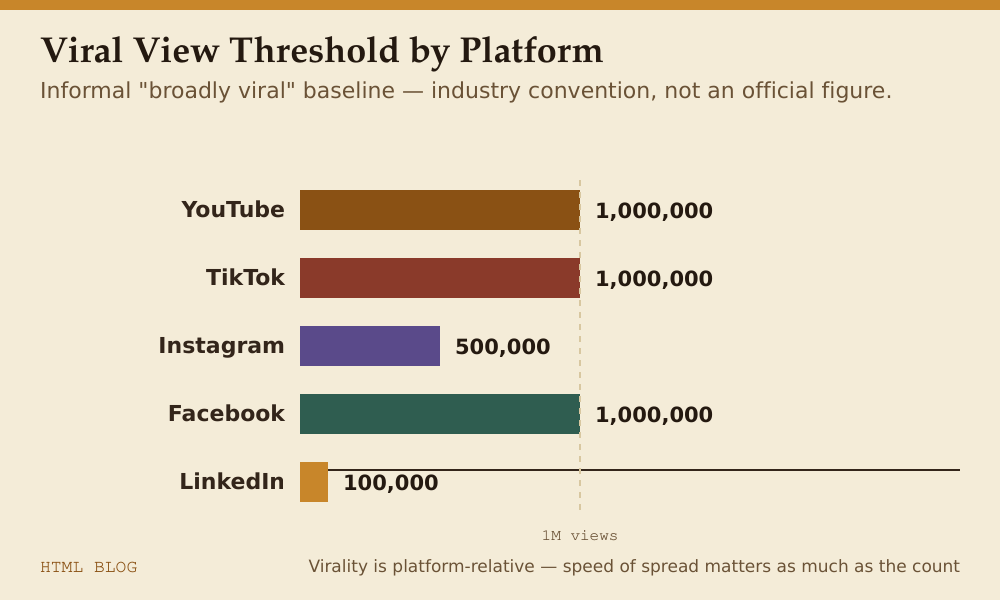
View counts by platform — what “viral” actually means
| Platform | Traction threshold | Viral threshold | High-level viral |
|---|---|---|---|
| YouTube | 100,000 views | 1 million views | 10 million+ views |
| TikTok | 500,000 views | 1 million views | 5 million+ views |
| Instagram Reels | 50,000 views | 500,000+ views (or 100,000+ likes) | 1 million+ views |
| Facebook video | 10,000 shares | 1 million views | 10 million+ views |
| X / Twitter | 10,000 retweets | No clean threshold — depends on follower count | Trending in a major country |
| 10,000 views | 100,000 views in 48–72 hours | 1 million+ views |
These figures are industry conventions, not official platform thresholds. The platforms themselves do not publish a “viral” definition. Use them as orientation, not hard rules.
What “viral” actually means
A video goes viral when its spread is primarily driven by sharing rather than by an existing large audience. The classic example: a creator with 500 followers posts a video that reaches 2 million views because viewers shared it outside their immediate network. That matters because it means virality is not a pure function of view count — it is about rate and mechanism.
The practical markers:
- Speed — most genuine virality happens within 24–72 hours of posting. A video accumulating 1 million views over six months is popular, not viral.
- Share-to-view ratio — high shares relative to total views indicate viewers felt compelled to distribute the content.
- Follower growth spike — a genuinely viral video almost always produces a visible follower jump on the posting account.
How many views is viral on YouTube?
YouTube is the highest-barrier platform for virality because it has the largest existing content library and the most established channels. A video with 1 million views in the first 24–48 hours from a small channel is a reliable viral signal. From a channel that already has millions of subscribers, 1 million views is simply a normal release.
Context note: PSY’s “Gangnam Style” reached 1 billion views in 159 days when it launched in 2012 — the first YouTube video to do so. That benchmark shifted the cultural understanding of what “viral on YouTube” means. Today’s platform has ten times the user base, so thresholds have risen accordingly.
How many views is viral on TikTok?
TikTok’s For You Page distributes content to non-followers by design, which means a single video from a brand-new account can reach millions of people. The flip side is that the average view count per video is lower than YouTube’s, since the platform floods users with content.
Most TikTok creators consider 500,000 views in the first week strong performance. One million views within 48 hours is a clear viral event. Five million views signals a video that has broken well outside TikTok’s own ecosystem into news coverage and other platforms.
How many views is viral on Instagram?
Instagram Reels is the closest format to TikTok on the platform. For Reels, 500,000+ views within a few days alongside heavy engagement (saves and shares weighted more heavily than likes by Instagram’s algorithm) is a common viral marker. For static posts, the threshold has historically been set at 100,000+ likes with the account having substantially fewer followers.
What makes a video go viral?
No formula guarantees it. But the content elements that consistently appear in viral videos are:
- An immediate hook — the opening two seconds must give the viewer a reason to stay. Most viral videos have something unusual, funny, or surprising in the first frame.
- Emotional charge — content that provokes a strong reaction (laughter, outrage, wonder, tenderness) gets shared. Content that provokes mild interest does not.
- Relatability or universality — the more people who can say “this is me” or “I know someone like this,” the further it spreads.
- Short format — attention spans are short, and platform algorithms tend to reward completion rate. Shorter videos have a structural advantage.
- Timing — content that taps a current cultural moment, news event, or trend rides existing momentum rather than creating its own.
Is virality worth chasing?
It depends on your goal. A viral video delivers a spike — views, followers, sometimes revenue. But the creators who build sustainable audiences usually do it through consistent, mid-level-reach content rather than waiting for a viral moment. A video with 50,000 highly targeted views from your actual audience is often more valuable than a 2 million view spike from people who will never return.
Frequently asked questions
- What is the minimum number of views to be considered viral?
- There is no official minimum. The informal industry consensus is 1 million views as a baseline, but context matters more than the raw number. A video with 250,000 views in 24 hours from an account with 1,000 followers is more “viral” in the meaningful sense than 1 million views spread over a year.
- Do views from the creator’s own account count?
- On TikTok and YouTube, creators’ own views on their content do not count toward the public view counter. On Instagram, your own views on a Reel do count — but the first play only, not repeated loops.
- Can an old video go viral later?
- Yes. If a popular account shares or reacts to older content, it can re-enter algorithmic distribution and accumulate views rapidly. This is sometimes called “going viral retroactively” and it happens regularly on TikTok and YouTube.