iPhones can get malicious software from websites, but true viruses — self-replicating programs that spread between files — are rare on iOS because Apple’s sandboxed architecture prevents them. The real risk is adware, spyware, and phishing scripts delivered through infected or fake websites, and it is a real risk if you tap the wrong link.
Here is what you need to know: how exposure happens, the signs something is wrong, and the practical steps to clear it.
How malware reaches an iPhone through a website
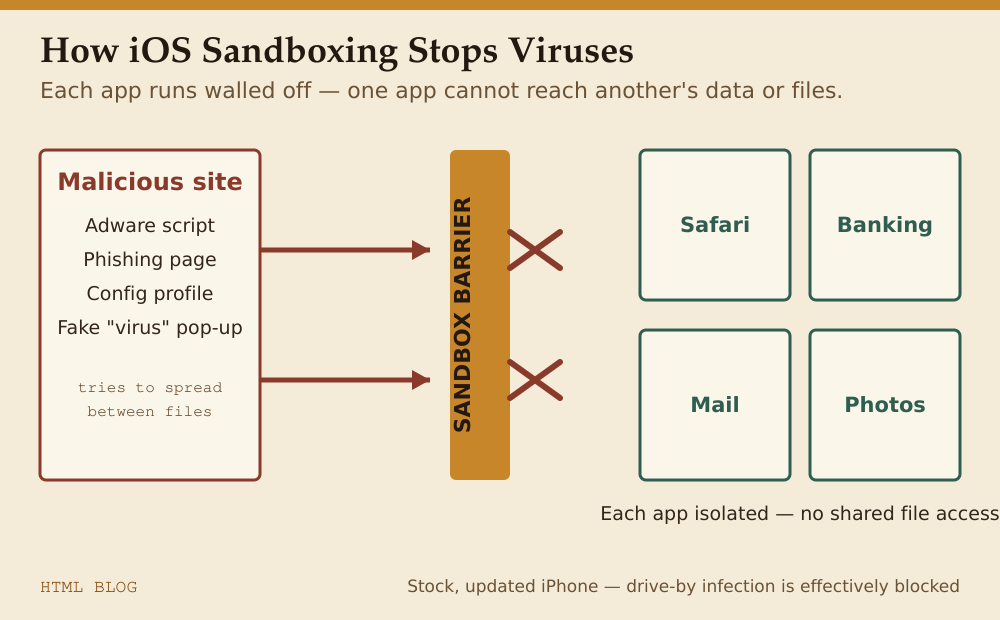
iOS runs every app inside a strict sandbox. One app cannot read another app’s data, and Safari cannot install executable files without your permission. That architecture makes drive-by infections — the kind that happen on Windows just by visiting a page — effectively impossible on a fully updated iPhone.
What does work against you:
- Phishing pages — sites disguised as Apple, your bank, or a package carrier that trick you into entering credentials.
- Malicious profiles — some sites prompt you to install a configuration profile, which can redirect traffic or grant device management permissions. Never install a profile from a site you don’t recognise.
- Jailbroken devices — removing iOS’s sandboxing constraints re-opens the attack surface. A jailbroken iPhone can catch malware the same way an Android phone can.
- Fake browser warnings — pop-ups claiming “your iPhone has a virus, tap to fix it” are scams. Apple does not send security warnings through web pages.
The bottom line: a stock, updated iPhone visiting ordinary sites is very well protected. Your biggest exposure is human, not technical — clicking convincing-looking links.
Signs something is wrong with your iPhone
- Unusual battery drain — background processes running without your knowledge consume power.
- Mobile data spikes — data being sent or fetched without your input.
- Persistent pop-ups in Safari — especially ones warning of infection or pushing you to call a number.
- Apps you didn’t install — on a jailbroken device this is a strong red flag. On a stock device, it is nearly impossible without your explicit consent.
- iPhone overheating at idle — a warm phone sitting on your desk doing nothing warrants a check.
- Unknown charges — some phishing pages harvest payment details rather than install anything locally.
None of these signs confirms malware on their own — a poorly optimised app causes the same battery drain. But if several show up together after visiting a suspicious site, take action.
How to check for issues on your iPhone
- Go to Settings → Privacy & Security → VPN & Device Management. Any profile installed without your knowledge should be removed immediately.
- Check Settings → General → VPN & Device Management → Installed apps for anything unfamiliar.
- In Settings → Cellular, scroll through app data usage. An app you don’t recognise using significant data is suspicious.
- Review Settings → Battery → Battery Usage for apps consuming power in the background without good reason.
- If you clicked a phishing link, change your Apple ID password and any other passwords you may have entered on that page.
How to remove a Safari browser hijack or adware
- Open Settings → Safari → Clear History and Website Data. This clears cookies, cached pages, and pop-up scripts.
- Disable Settings → Safari → Allow Pop-ups if it’s on.
- Enable Settings → Safari → Fraudulent Website Warning.
- Close all Safari tabs: long-press the tabs icon and tap “Close All Tabs.”
- If pop-ups are coming from a specific site, go to Settings → Safari → Advanced → Website Data, find that domain, and swipe to delete it.
- Restart your iPhone — this clears session data and kills any scripts running in memory.
For persistent problems after all of the above: Settings → General → Transfer or Reset iPhone → Erase All Content and Settings is a clean slate. Restore from a backup made before the problem started.
Safe browsing habits that prevent the problem
- Keep iOS updated — Apple patches exploits quickly. Old iOS versions are the main vulnerability.
- Only install apps from the App Store. Sideloading via profiles is how most real iOS malware spreads.
- Never enter your Apple ID or payment details on a page you reached by tapping a link in a text or email — go directly to the site instead.
- If a browser pop-up warns you of a virus, close the tab. Apple does not send security alerts through websites.
- Consider a content blocker in Safari (1Blocker, AdGuard) — these prevent many malicious ads from loading at all.
What if you clicked a phishing link?
Act quickly. Disconnect from Wi-Fi (or turn on Airplane Mode) to stop any ongoing data transmission. Then:
- Change your Apple ID password at appleid.apple.com.
- Change passwords for any accounts whose credentials you may have entered.
- Check for unfamiliar purchases in the App Store and in your bank account.
- If you entered financial details, contact your bank to flag potential fraud.
- Enable two-factor authentication on your Apple ID if it isn’t already on.
Can iPhones get viruses from email?
Opening a plain email cannot infect your iPhone — the Mail app doesn’t run embedded scripts. The risk is the same as with websites: tapping a link in the email that leads to a phishing page or prompts you to install a profile. Delete any email that asks you to install software or click through to “verify” your account.
Can iPads get viruses from websites?
iPads run the same iPadOS sandboxing architecture as iPhones. The risks and protective steps are identical. An up-to-date, non-jailbroken iPad visiting ordinary websites is very well protected.
Frequently asked questions
- Can an iPhone get a virus just by visiting a website, without tapping anything?
- On a fully updated, non-jailbroken iPhone: no. Known drive-by exploits are patched quickly by Apple and require specific unpatched vulnerabilities. Keep iOS updated and the risk is negligible.
- Does Apple have a built-in virus scanner?
- iOS does not ship with a traditional virus scanner — the sandboxed architecture makes one largely unnecessary. Third-party “antivirus” apps on the App Store cannot scan other apps’ files; what they mainly offer is VPN services and phishing-URL blockers, which have limited value.
- What is the fake Apple virus warning that appears in Safari?
- It is a scareware pop-up, not a real alert. These pages use JavaScript to prevent you closing the tab or to loop an alert dialog. Close the tab, go to Settings → Safari → Clear History and Website Data, and restart Safari. Do not call any phone number shown in the warning.
- How do I know if my iPhone has been hacked?
- Look for unexplained battery drain, data usage spikes, unfamiliar device management profiles (Settings → VPN & Device Management), and charges you don’t recognise. If you suspect compromise, change your Apple ID password immediately and review active sessions at appleid.apple.com.